
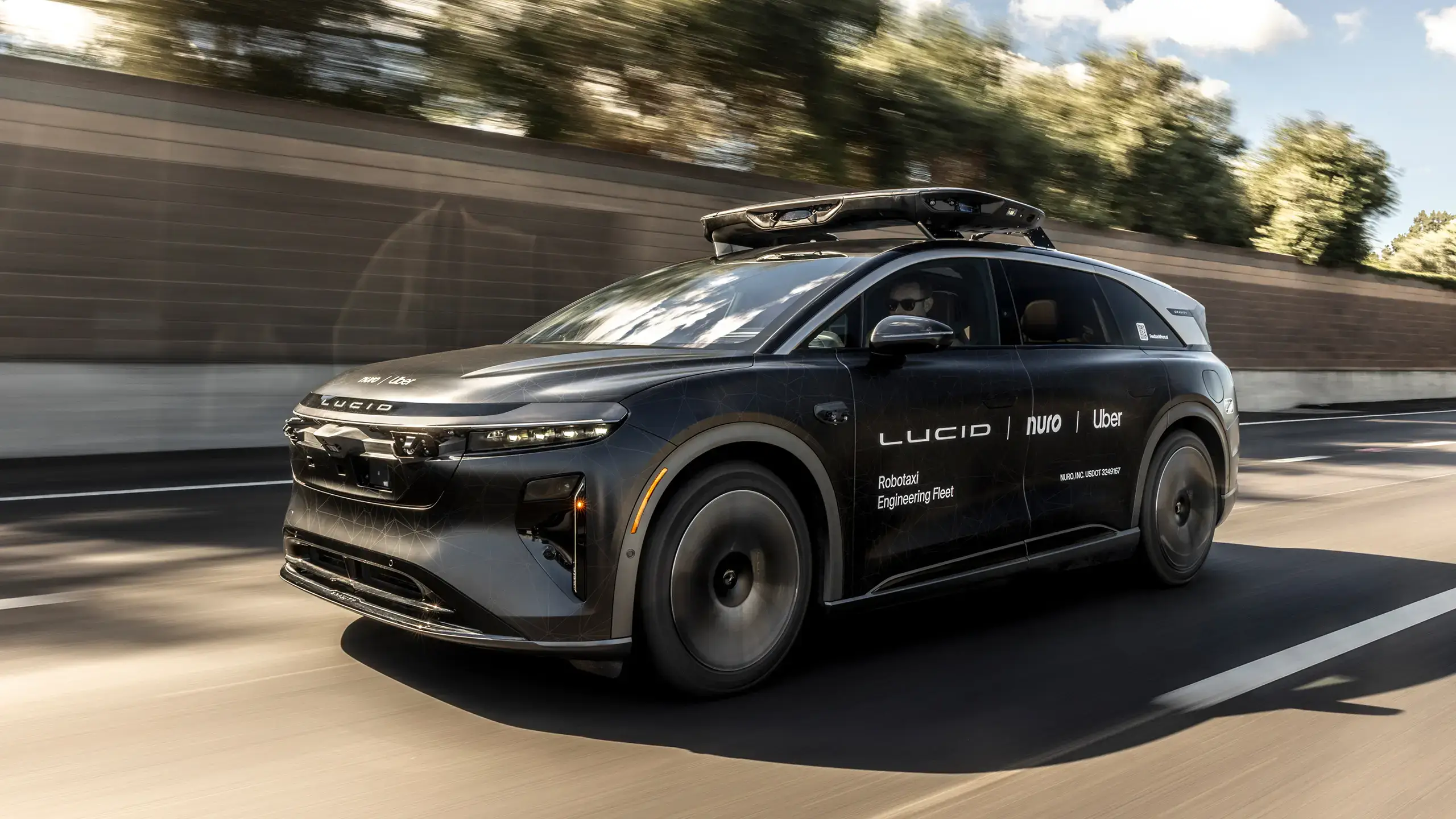
The Lucid Gravity robotaxi just lost its safety driver. As of today, Gravity SUVs running Nuro’s self-driving system are testing on public roads in the San Francisco Bay Area with no one behind the wheel, and Uber plans to open rides to the public in early 2027. If that partnership sounds familiar, it should: Uber is building a very similar one with Rivian.

What Lucid, Nuro and Uber announced
- No one behind the wheel. Fully driverless testing started November 24 in Palo Alto, Mountain View, Los Altos and Sunnyvale, with more Bay Area cities coming next year.
- Employees ride first. Employee rides in the driverless cars start soon. The public launch in the Bay Area is planned for the first quarter of 2027.
- 100+ robotaxis ready. Lucid has delivered a fleet of more than 100 Gravity robotaxis with updated hardware, software and rider features.
- How they got here. A year of round-the-clock testing with a safety driver in the Bay Area and Houston, plus closed-course testing in Las Vegas. Nuro is one of just six companies with a California permit to test with no driver.
- The hardware. Cameras, lidar and radar, with a roof-mounted “halo” that houses the sensors.
- The scale. Uber has committed to buy at least 35,000 Lucid vehicles with Nuro’s system, including future Lucid midsize models, and plans to expand to dozens of markets worldwide.
Source: Nuro, Lucid and Uber announcement, November 24, 2026.
How the Lucid Gravity robotaxi compares to Rivian’s Uber deal
- Who builds what. Lucid’s robotaxi is a three-company effort: Lucid builds the vehicle, Nuro supplies the self-driving system and Uber runs the service. Rivian builds both the R2 and its self-driving system itself.
- Timing. Lucid and Nuro plan public rides in early 2027. Rivian’s R2 robotaxis are planned for San Francisco and Miami in 2028.
- Scale. Uber has committed to at least 35,000 Lucid vehicles. Its Rivian deal starts with 10,000 R2 robotaxis, with an option for up to 40,000 more starting in 2030.
- The vehicle. The Gravity is a large luxury SUV. The R2 is a smaller, more affordable one.
Source for the Rivian deal: TechCrunch, March 19, 2026.
What’s next for the Lucid Gravity robotaxi
- Employee rides. Lucid, Nuro and Uber employees start riding in the driverless Gravity soon.
- Public rides in early 2027. Uber plans to open the service in the Bay Area in the first quarter of 2027, with Houston also planned for 2027.
- Rivian’s turn on December 9. Rivian’s Autonomy & AI Day is the next chance to see how far its own robotaxi tech has come.
My take as an R1S and R2 owner
Lucid going driverless first doesn’t worry me. If anything, it makes me more excited about the autonomy race. More competition means faster innovation, and right now the main players are Tesla, Waymo, Zoox, Rivian and Lucid.
If I were building this tech, I’d want Rivian’s approach. You always want to be self-reliant, and Rivian controls both the vehicle and the software instead of depending on partners.
Uber’s strategy makes sense too. It has clearly passed on building its own vehicles and is letting everyone else battle it out. If I’m Uber, the more the merrier, and different vehicle sizes are useful for ride-sharing.
Would I ride in one? Absolutely. So far I’ve only ridden in a Tesla on FSD V14 and a Waymo in San Francisco, and I want a lot more time in the passenger seat.
Which vehicle makes sense depends on where you are. In Boston, where I live, a smaller R2 or a Tesla robotaxi fits best. Something as big as the Gravity only works when you’re riding with a group.
Which robotaxi would you get into first? Tell me in the comments.
Leave a Reply